



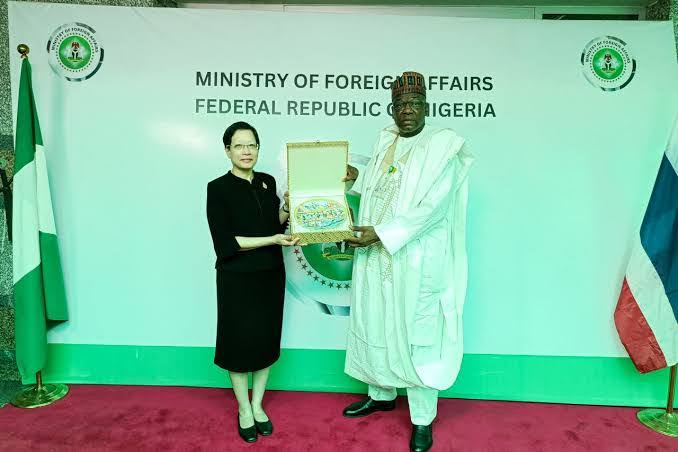
Nigeria and Thailand are considering a broader strategic partnership aimed at expanding cooperation beyond their traditional focus on crude oil and rice.
The proposed shift would place greater emphasis on areas where Thailand has developed significant expertise, particularly agricultural technology, food production, healthcare, renewable energy and intermediate technology.
The issue was raised during a meeting at the Presidential Villa in Abuja, where Vice President Kashim Shettima hosted a Thai delegation led by Thailand’s Deputy Prime Minister and Minister of Foreign Affairs, Yousef Hassan Khalawi.
Representing President Bola Tinubu, Shettima said the relationship between the two countries should evolve from a largely commercial arrangement into a wider strategic partnership.
He noted that Nigeria’s large consumer market, youthful population and natural resources could make the country an attractive destination for Thai investment.
According to the Vice President, agriculture, ICT, renewable energy and solid minerals are among the sectors where increased collaboration could deliver significant economic benefits.
He also encouraged Thai businesses to view Nigeria as more than a destination for bilateral trade, describing the country as a potential gateway into the broader African market.
Thailand outlines Africa strategy
Khalawi described Nigeria as an important partner in Thailand’s engagement with Africa, particularly because of its position and influence in West Africa.
He also welcomed the economic reforms being pursued by the Tinubu administration.
The Thai government is developing a broader framework known as the Thailand-Africa Initiative, which is expected to promote stronger economic relationships and greater people-to-people connections between Thailand and African countries.
Agriculture is expected to be one of the initiative’s central areas, alongside healthcare and tourism.
Khalawi said Nigeria’s expanding digital economy and its position within the Global South further strengthen the case for deeper cooperation between both countries.
Rice production remains an area of opportunity
The renewed discussions follow Thailand’s recent donation of 12 metric tonnes of rice, worth about $22,000, to support communities experiencing food insecurity in Nigeria.
The rice was given to the World Food Programme for distribution, with vulnerable communities, including those in the North-East, among the intended beneficiaries.
Thailand’s experience in rice cultivation, processing and agricultural technology could also provide useful lessons for Nigeria as the country works to increase local food production.
Thailand produces an estimated 34.3 million metric tonnes of rice annually and is one of the world’s major rice exporters.
Rather than limiting future cooperation to the exchange of agricultural commodities, Nigerian officials are seeking access to the technology, expertise and production systems that have helped Thailand develop its agricultural sector.
A wider economic relationship
The proposed expansion of bilateral relations fits into Nigeria’s broader push to attract foreign capital, improve domestic production and use technology to accelerate economic growth.
For Nigeria, stronger ties with Thailand could create opportunities to transfer expertise in areas such as modern farming, food processing, renewable energy, healthcare and intermediate technologies.
Such cooperation could also strengthen agricultural value chains, increase productivity, generate employment and create new opportunities for farmers and businesses.
Thailand, meanwhile, would gain access to Nigeria’s large domestic market and its strategic position as an entry point into West Africa.
If the proposed shift moves forward, the relationship could mark a transition from a narrow trade partnership centred on commodities toward a more diversified economic and technology-focused alliance.
