



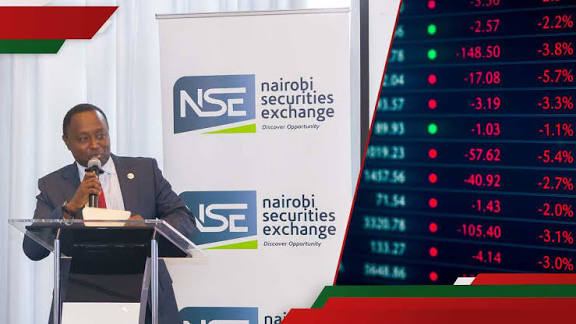
The Nairobi Securities Exchange closed Thursday, September 16, 2026, at a market capitalisation of Ksh3.948 trillion — dropping below the Ksh4 trillion psychological mark for the first time since it crossed that line in August.
The decline extends a sell-off that has wiped about Ksh337 billion off the record Ksh4.285 trillion valuation reached on September 3, 2026.
What makes the reversal notable is its unevenness. A handful of large, liquid counters — Safaricom, Equity Group, KCB Group, Co-operative Bank, and Absa Bank Kenya — account for much of the lost value, underscoring how heavily the NSE’s overall valuation leans on its biggest names.
Blue Chips Lead the Fall
Safaricom has taken the heaviest hit over the latest two trading sessions, shedding Ksh52.1 billion in market capitalisation. Co-operative Bank lost Ksh24.9 billion, Equity Group Ksh21.7 billion, KCB Ksh18.5 billion, and Absa Ksh16.3 billion.
The pattern stands out because these were the same stocks that powered the market’s record run.
On September 3, 2026, Equity traded at Ksh106, KCB at Ksh98.55, and Co-operative Bank at Ksh38.55 — all-time highs at the time. Safaricom was also at a multi-year high of Ksh37.94. By Thursday, their prices had fallen to Ksh96, Ksh84.25, Ksh31.95, and Ksh35.20 respectively.
“This is a correction on large counters over the last couple of days, as investors continued taking profits and locking in substantial capital gains after the strong rally,” said Melodie Ndanu, a research analyst at Standard Investment Bank.
Profit-Taking, Not Abandonment
The figures suggest investors are not simply walking away from Kenyan equities. Some are crystallising gains after a powerful rally, while international investors reassess the risk-return equation for frontier markets.
Foreign investors sold a net Ksh4.55 billion of Kenyan shares in August — their biggest monthly outflow in 10 months. They followed with further net outflows of Ksh1.6 billion in the first two weeks of September, according to market data.
That matters because offshore investors tend to concentrate on the NSE’s biggest and most liquid counters, including Safaricom, Equity, KCB, Co-operative Bank, and EABL. It makes the market especially sensitive to shifts in global risk appetite.
Global Headwinds
The latest pressure comes as global investors grapple with higher US yields, geopolitical tensions, and renewed inflation concerns. The yield on the US 10-year Treasury bond has reached the 5 percent threshold, while the Federal Reserve raised its benchmark rate by 25 basis points. Higher US yields can make dollar-denominated assets more attractive relative to riskier frontier-market investments.
“Foreign investors may also be using the rally opportunity to exit and reallocate funds toward safer global assets as the global outlook shifts,” Ndanu said.
That leaves a crucial question for NSE investors: is this decline simply a profit-taking episode after an exceptional rally, or the start of a longer repricing of Kenyan equities?
Local Investors Step In
Part of the answer lies in whether foreign selling persists — and whether local institutional investors keep absorbing the shares being offloaded.
There is evidence local investors have been raising their exposure. Pension funds increased their listed-equity holdings by Ksh130.51 billion in the six months to June, taking the value of their equity investments to Ksh443.35 billion, according to Retirement Benefits Authority data.
Central Bank of Kenya (CBK) data also shows the sell-off has come with heavier trading activity: 178.71 million shares changed hands in the week to September 17, while equity turnover rose 44.75 percent to Ksh9.27 billion. Market capitalisation fell 4.96 percent to about Ksh3.95 trillion.
The Real Question
For investors, the key issue is not simply whether the NSE has fallen below Ksh4 trillion. It is whether the market can broaden beyond its heavyweight counters while global investors reassess frontier-market risk.
The extraordinary rally created substantial paper wealth. The current sell-off is revealing how quickly that wealth can reverse when the market’s biggest stocks move in the same direction.
