



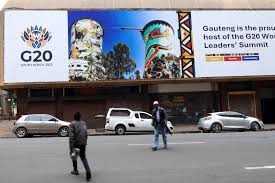
The upcoming G20 summit in South Africa is set to unfold under unusual circumstances, as U.S. President Donald Trump’s decision to skip the gathering creates both diplomatic tension and a strategic opening for the hosts. South Africa, determined to use its position to elevate African priorities on the global stage, now has a rare opportunity to shape the agenda without resistance from Washington’s often skeptical voice on multilateral cooperation.
The White House confirmed that the U.S. will not attend the first-ever G20 summit hosted on African soil, citing allegations that post-apartheid South Africa discriminates against white citizens — a claim strongly rejected by Pretoria. Trump has also refused to endorse the summit’s central themes: global climate resilience, support for developing economies facing mounting debt, and a push toward cleaner energy systems.
Although the absence of the world’s largest economy prevents the possibility of major joint declarations, the meeting remains a historic milestone for Africa. The continent, home to abundant mineral resources, fast-growing markets, and a young labour force, is using this moment to showcase its emerging influence. Still, Trump’s nonattendance will be impossible to ignore, especially given the symbolic tradition scheduled for the closing ceremony.
At the end of the summit, South African President Cyril Ramaphosa is expected to hand over the G20 presidency to the next host — the United States. With Trump missing, the gesture becomes a symbolic handover to an empty chair. “I don’t want to hand over to an empty chair, but the empty chair will be there,” Ramaphosa remarked during preparations in Soweto. He added that he would hand over symbolically and then speak with Trump directly afterward.
A Leadership Gap Creates New Openings
South Africa aims to use its hosting role to spotlight issues that often receive inadequate global attention: preparing nations for climate-driven disasters, improving the conditions of debt for low-income countries, accelerating the energy transition, and ensuring that Africa’s critical minerals bring real value to producing countries.
Several other notable leaders will also be absent. Trump ally and Argentine President Javier Milei has declined to attend for ideological reasons. Vladimir Putin will not come due to the International Criminal Court warrant issued over the Ukraine conflict. China is sending Premier Li Qiang in place of President Xi Jinping.
Geopolitical analyst Chris Vandome of Chatham House believes the U.S. withdrawal leaves space for others — particularly European powers and China — to take a more assertive role. “Without the U.S. playing its traditional role, forums like the G20 become even more important for cooperation,” he noted.
Political analyst Piet Croucamp added that Trump’s absence might actually benefit the event. With growing concerns over hostile rhetoric from U.S. officials — including Vice President JD Vance’s clashes with European partners — he suggested a U.S. presence could have overshadowed the summit. “Trump not coming to South Africa may be the best thing that could happen to the G20,” he said.
A Platform for African and Global Voices
The summit provides a global stage for countries eager to deepen engagement with Africa. France’s President Emmanuel Macron is expected to highlight energy transition partnerships, establish a Franco-South African business council, and honour French contributions to the fight against apartheid. Other nations are exploring bilateral agreements and collaborations on the sidelines.
Experts also highlight the collective opportunity for African nations, especially with the African Union participating as a formal representative of the continent. Busisipho Siyobi of Good Governance Africa emphasized that discussions around critical minerals must include greater fairness for African producers. She also pointed to Africa’s enormous energy needs — with 600 million people still lacking electricity — making the clean-energy transition a core priority.
The Challenge: A Fractured Multilateral World
Yet despite South Africa’s efforts, expectations for transformational outcomes remain low. The G20 has struggled for years to reach consensus, particularly around climate change responsibilities. According to officials familiar with pre-summit discussions, the U.S. had previously signaled its intent to block references to climate change entirely.
Veteran journalist Steven Friedman summed up the broader dilemma: “South Africa wanted it to be about keeping multilateralism alive — a noble idea, but it goes against the global tide. At the moment, multilateralism is dead.”
While Trump’s empty chair will symbolize the divisions facing global diplomacy, the summit may still give South Africa and its partners space to push forward African priorities and foster cooperation among nations willing to engage constructively.
