


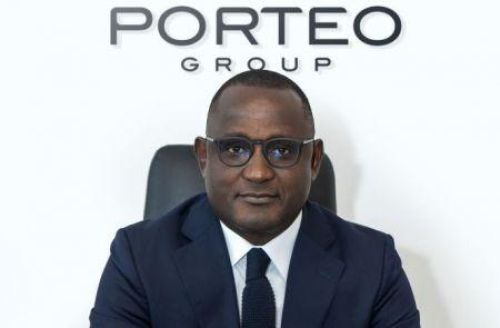
Former AFD Director of Resource Mobilization and Partnerships and current CEO of Porteo Group, Papa Amadou Sarr, shared deep insights on Africa’s industrial transformation and investment climate during an interview with Ecofin Agency at the Choiseul Africa Business Forum held on November 4–5, 2025 in Morocco. As the head of the pan-African construction and infrastructure group, Sarr emphasized that Africa must take bold steps to reduce investment risks, reform infrastructure financing models, and expand joint ventures to strengthen regional industrial value chains.
Experience at AFD and Its Influence on His Work at Porteo
Reflecting on his former role at the French Development Agency (AFD), Sarr noted that overseeing partnerships and resource mobilization gave him a clearer understanding of the significant role the private sector now plays in Africa’s development journey.
According to him, the private sector is central to job creation, infrastructure development, and public-private partnerships that support core services like water, sanitation, and education. However, he stressed that governments must still create a business climate that allows private companies to thrive.
He added that his experience at AFD—and previously in the Senegalese government—prepared him to strengthen Porteo’s operational efficiency and bring the company closer to international benchmarks.
Balancing Public Sector Discipline and Private Sector Competitiveness
Sarr explained that although public institutions and private companies operate differently, both sectors currently face similar pressures. With global aid budgets shrinking and competition for available financing intensifying, efficiency and strategic resource management are now crucial.
He highlighted that 90% of Porteo’s clients are national or regional governments, meaning the company must maintain strict discipline, ensure transparency, manage costs, and remain competitive—much like public institutions operating within budget constraints.
Porteo’s Expansion Strategy Across Africa
Porteo currently operates in eight countries, and Sarr said the next three to four years will focus on expanding across ECOWAS and entering new markets in East Africa, especially in English-speaking countries.
The group aims to finalize a new strategic plan in early 2026, targeting operations in 10 to 15 African countries, surpassing €1 billion in annual revenue, and ultimately doubling or tripling that figure. Achieving these goals requires building stronger internal teams and enhancing technical and managerial capacity.
Industrialization as Africa’s Next Growth Engine
Sarr believes Africa is entering a new phase of industrial growth, propelled by the African Continental Free Trade Area (AfCFTA) and increasing regional integration.
He stressed that industrial parks, special economic zones, and free zones are essential for transforming Africa into a manufacturing base.
Above all, Africa must process more of its raw materials—whether agricultural, mineral, or extractive—to retain more value on the continent.
He added that Porteo is already vertically integrating its supply chain by producing key construction materials such as timber, aluminum, and concrete. This aligns with Agenda 2063 and the AfCFTA’s long-term goal of strengthening Africa’s manufacturing capabilities.
Reforming Infrastructure Financing and De-Risking Investment
For Sarr, the biggest barrier to long-term infrastructure investment in Africa is country risk, which he argues is often exaggerated by rating agencies, banks, and export credit institutions. This perception raises the cost of capital and discourages investors from financing projects requiring commitments of 15–30 years.
He insists that Africa must “de-risk again and again” by improving its business environment, while development partners must also rethink how they evaluate African markets so that financing can become more accessible and affordable.
Key Corridors That Will Shape Africa’s Economic Future
Looking toward 2030 and 2060, Sarr identified three critical regional corridors that will significantly impact industrial development, trade, and logistics:
-
The East African Corridor connecting Nairobi to Mombasa.
-
The Southern Corridor linking South Africa with neighboring markets.
-
The North-South Corridor driven by Morocco, stretching through Dakhla toward Mauritania, Senegal, and Mali.
These corridors are vital for transporting manufactured goods, minerals, and other commodities to major ports, especially for landlocked countries such as Mali or Burkina Faso.
Porteo’s Role in Future Infrastructure Projects
Sarr confirmed that Porteo intends to participate actively—whether through consortiums or direct project development—in major infrastructure ventures across the continent.
The company is already engaged in West and Central Africa, including Gabon, and plans to expand into East Africa, beginning with Tanzania, Kenya, and Rwanda. He emphasized that Porteo will continue forming strong partnerships and joint ventures with African and international firms to build roads, bridges, ports, airports, and industrial facilities.
