
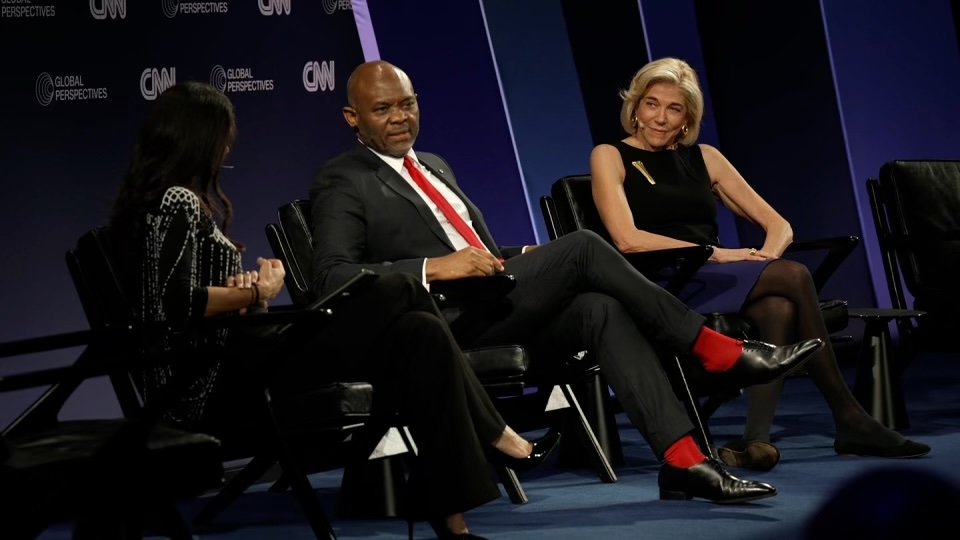
In November 2025, Tony O. Elumelu, CFR, renowned entrepreneur and Founder of the Tony Elumelu Foundation, participated in a major dialogue at CNN’s Global Perspectives on Africa event held in London. The session, moderated by CNN’s Eleni Giokos, also featured Lady Lynn Forester de Rothschild, Founder and CEO of the Council for Inclusive Capitalism. Together, they explored the growing impact of Africapitalism and the emergence of a new, more inclusive global economic model shaped by African perspectives.
The discussion focused on how Africa’s private sector and its rising generation of entrepreneurs are driving sustainable development, building stronger communities, and influencing global market systems in transformative ways. Elumelu emphasized that the world has been navigating multiple crises—ranging from serious inequality to social exclusion and environmental pressures—which inspired the evolution of the Africapitalism philosophy.
He clarified that Africapitalism is not simply an African version of capitalism, but a reimagining of capitalism itself. It is designed to address long-standing structural issues by placing community, inclusion, and shared prosperity at the center of economic activity. According to him, in the 21st century, capital must work for society—not just for shareholders—by creating value that lasts.
Elumelu explained that profit and purpose are complementary, not conflicting forces. For Africa’s renaissance to thrive, private sector investment must be directed toward sectors that generate economic prosperity while uplifting communities. He stressed that inclusive capitalism is not charity—it is value creation and long-term thinking.
This principle guides the work of the Tony Elumelu Foundation. Elumelu noted that he and his wife believe true success is not measured by private wealth but by the positive impact one creates. He also acknowledged Lady Lynn Forester de Rothschild, a founding board member who served with the Foundation for twelve years.
The Foundation’s flagship entrepreneurship programme reflects this commitment. Each year, between 3,000 and 5,000 young entrepreneurs across all African countries receive $5,000 in non-refundable seed capital, along with training and mentoring. For Elumelu, empowering young Africans is the most strategic investment of all—one that accelerates prosperity and strengthens the continent.
He explained that Africapitalism shifts focus from extraction to creation, from consumption to production, and from dependency to dignity. It encourages Africa to stop exporting raw materials and instead build local value chains, ultimately reducing unemployment. Elumelu expressed deep concern over high youth unemployment, calling it a “betrayal” if African leaders fail to generate opportunities for the next generation.
Elumelu also addressed global economic alignment. He argued that Africa must partner with nations and institutions whose visions align with its long-term priorities—job creation, youth empowerment, innovation, and inclusion. Any global partner that strengthens these pillars, he said, is one worth aligning with.
As the world enters an era shaped by technology—particularly artificial intelligence—Elumelu emphasized the need for massive infrastructure investment to help Africa compete. He recently attended discussions in Riyadh on AI and reiterated the continent’s need to integrate modern technologies into its economic systems.
His remarks concluded with a powerful message: Africa’s transformation will come from empowering its people and enabling its private sector, not from external charity. Africapitalism, he said, is the pathway to that future.
