

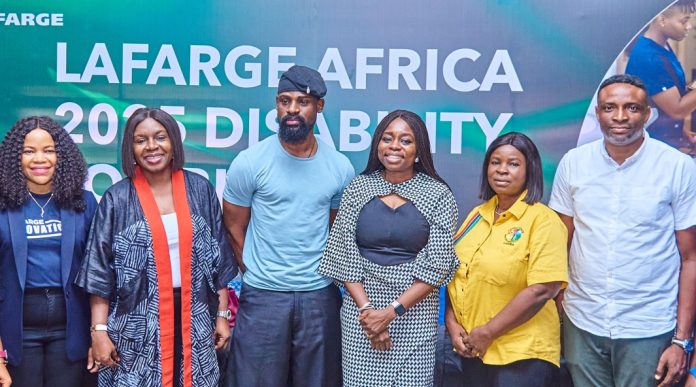
Lafarge Africa Plc, one of Nigeria’s foremost building solutions companies, is stepping up its commitment to inclusion by investing in the skills and entrepreneurial capacity of persons with disabilities (PWDs)—a demographic often overlooked in national workforce development efforts. In honour of the International Day of Persons with Disabilities, the company hosted participants of its Disability-to-Ability (D2A) Programme, an initiative aimed at equipping PWDs with practical, income-generating skills and supporting their transition into sustainable livelihoods.
The D2A Programme, launched under the theme “Ability Reimagined,” is designed to train 100 individuals across four vocational tracks: laptop and phone repairs, make-up and gele artistry, wig and braid production, and shoe and bag making. Implemented in partnership with the Lagos State Employment Trust Fund (LSETF), the Lagos State Ministry of Youth and Social Development, the Lagos State Office for Disability Affairs (LASODA), and Chess in Slums Africa led by Tunde Onakoya, the initiative demonstrates how corporate social responsibility can intersect with public-sector support to drive truly inclusive economic development.
With training hubs located in Ikeja (Lagos West) and Ikorodu (Lagos East), Lafarge aims to ensure wide accessibility for participants across the state. This dual-hub model underscores the company’s focus on removing both physical and systemic barriers to participation. It also aligns with the growing shift among Nigerian corporations toward embedding social impact into core business strategy—especially as Environmental, Social and Governance (ESG) priorities increasingly shape investor expectations.
Speaking during the event, Viola Graham-Douglas, Lafarge Africa’s Director of Communications, Public Affairs & Sustainable Development, described the programme as a testament to the company’s long-standing values of empowerment and community development. She noted that the D2A initiative goes beyond technical training, offering mentorship, financial literacy programmes, and entrepreneurship coaching, all supported by LSETF.
“We don’t just produce building solutions; we build society, homes, and empower people to be the best they possibly can be,” she stated.
A central aim of the programme is to create a steady pipeline of micro-entrepreneurs who can thrive in Nigeria’s informal economy—an economic segment that provides over 60% of the country’s employment opportunities. By equipping PWDs with marketable skills, Lafarge is tackling long-standing structural challenges that have prevented many disabled individuals from accessing viable economic opportunities.
Renowned chess champion and social entrepreneur Tunde Onakoya, known for his advocacy for youth and disability inclusion, shared his personal story to motivate participants. Despite facing significant challenges in his childhood, Onakoya used chess and education as a pathway to global impact.
“Your skills are a blessing. Be diligent, believe in yourself, and use what you have to create value,” he encouraged.
The strong presence of Lagos State government officials further reinforced the collaborative force behind the initiative. Feyisayo Alayande, Executive Secretary of LSETF, conducted a speed-mentoring session offering participants valuable insights on entrepreneurship strategy, business planning, and managing micro-enterprises.
In addition, Adekola Oluwafunmilayo, Director of Monitoring and Evaluation at LASODA, highlighted the shared responsibility required to achieve genuine inclusion:
“Building an inclusive society does not rest with government alone. It requires compassion, consistent effort, and partnership from every stakeholder.”
Through D2A, Lafarge Africa continues to demonstrate that empowering persons with disabilities is not an act of charity, but a strategic investment in human potential, economic resilience, and a more equitable future.
