

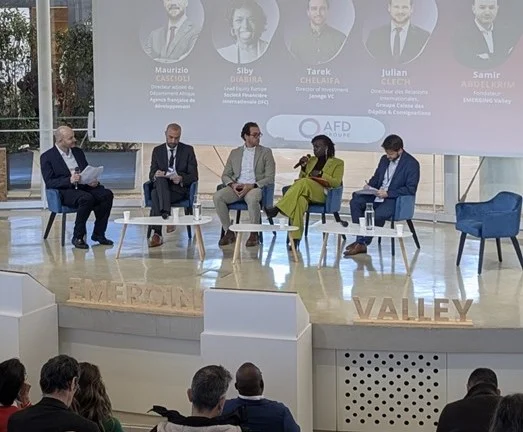
For years, discussions around technological innovation in Africa were framed in terms of future potential — possibilities waiting to be unlocked someday. Today, that narrative has shifted dramatically. Innovation on the continent is no longer theoretical; it is actively unfolding, shaped by Africa’s own social dynamics, economic realities, and local challenges. A new generation of founders, investors, and policymakers is building an ecosystem that does not simply borrow dominant global models. Instead, Africa is redefining them, and the world is taking notice at Emerging Valley, where these ideas and innovations converge.
During the 9th edition of the event, held on 26 November, numerous leaders stressed the importance of cultivating investment from within Africa itself. More than 120 speakers, 40 investment funds, and a growing network of builders came together to champion an impact-driven generation. This shift is equally visible in the cities shaping this movement. Marseille, historically known for its role as a logistical port, is transforming into a major innovation hub bridging Africa, Europe, and increasingly Asia. According to Samir Abdelkrim, founder of Emerging Valley, the city has become the meeting point where startups, investors, diaspora communities, and institutions connect — often for the very first time.
Vincent Languille, metropolitan councillor for International Relations and European Funds, describes the event as the only platform where entrepreneurs and investors from Africa, Europe, and Asia engage in genuine dialogue. The innovation landscape has drastically changed compared to a decade ago. New tech hubs are emerging, countries are accelerating their digital transitions, and others are reinventing themselves altogether. Despite this momentum, African startups still face a difficult funding environment. Uwem Uwemakpan, Head of Investments at Launch Africa, acknowledges that fundraising remains challenging, requiring strong storytelling and persistence.
Yet global perceptions are shifting, especially in the Gulf region. Faten Aissi, Partnership Director at Flat6Labs, notes that Gulf investors increasingly view Africa not as a high-risk market but as a strategic opportunity. Still, structural issues remain — limited mobility, high travel costs, legal complexities, and scarce cross-border financial tools. Aissi also highlights cultural gaps: many business deals are negotiated in social spaces where women are often excluded. Ensuring women are present “in the right rooms,” she argues, is essential to combat intentional biases.
Africa’s push for innovation is deeply rooted in its own needs. Zineb Saidi, Communication and Marketing Director at Technopark Morocco, emphasizes that African challenges require African-designed solutions. She points to startups addressing issues such as diploma verification or local export demands. Nearly 36% of Technopark’s incubated startups now export their services, with almost half serving other African markets — proof that internal value creation precedes global scale.
In Agadir, the startup Sand to Green is turning desert areas into sustainable agricultural zones. Their work has earned global recognition and even investment from a Norwegian fund. To speed up operations, a public administrator works directly from their offices to reduce administrative delays — an innovation in governance itself. A similar approach is seen at Novation City in Tunisia, where a deeptech cluster focused on AI, Industry 4.0, and automotive technology is emerging, with 45% of its projects led by women, marking a quiet but powerful shift in gender representation.
According to Adil Tourabi, Sales Director for Africa–Middle East at OVHcloud, the idea of a single “African market” is misleading. Each country has its own realities and must be approached individually — especially in sectors like cloud infrastructure. Ahcène Gheroufella, Deputy Director at Expertise France, adds that a nation cannot draft an AI strategy without first defining the type of technological sovereignty it hopes to build.
Across Africa and its diaspora, new alliances are forming in fields like data, finance, agritech, energy, logistics, and industry. Cities such as Marseille are becoming symbolic of this growing influence, where African entrepreneurs express that they finally feel respected and included. The city’s longstanding connection with Dakar and its strong representation of Tunisian startups in the PACA region illustrate how deeply intertwined the innovation pathways have become.
Still, important questions remain: Where are the binational talents in these conversations? Are their voices fully valued? As regional investment funds rise, new startup hubs proliferate, and cultural confidence strengthens, one reality becomes clear — Africa is no longer waiting for invitations. It is defining its own agenda, shaping its own innovation roadmap, and forging its own destiny. What comes next is already taking shape, ideally through solutions developed and deployed on African soil.
