



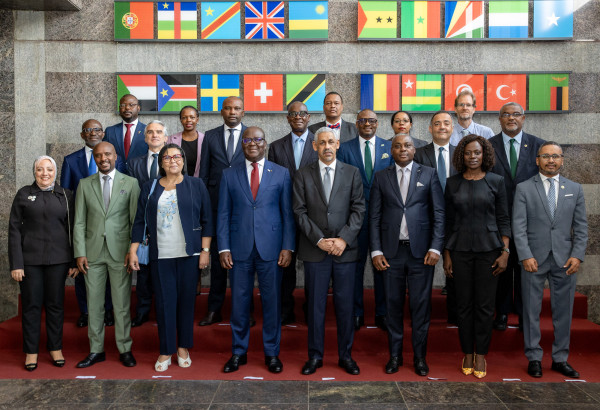
The African Development Bank Group (AfDB) began a two-day series of high-level consultations on Tuesday with various African development finance institutions and private sector financial partners. The explicit goal of these meetings is to collaboratively develop a bold and historic blueprint for a New African Financial Architecture, which is critically needed to bridge the substantial financing gap that currently hinders the continent’s numerous development needs.
At the personal invitation of the Bank Group president, Dr. Sidi Ould Tah, more than 50 influential representatives from both regional and continental banks and development finance institutions (DFIs) are convening at the African Development Bank Group headquarters in Abidjan, Côte d’Ivoire. Dr. Ould Tah characterized these talks as absolutely vital to securing the continent’s long-term destiny.
“As the essential architects of Africa’s capital markets, you serve as the custodians of key financial institutions and are the catalysts for our continent’s future growth,” Dr. Ould Tah stated at the commencement of the first session, which gathered the heads of African securities exchanges, private equity funds, and venture capital funds.
This particular meeting marks the first time that the Bank has convened a gathering of this kind specifically with African stock exchange leaders. The primary aim is to thoroughly explore and define their role in providing long-term financing, focusing heavily on reforming the current mechanisms by which Africa’s domestic capital is mobilized and deployed. Dr. Felix Edoh Kossi Amenounve, CEO of the West African Regional Stock Exchange (BRVM), expressed his support for the meeting, emphasizing the necessity of fundamental structural change.
“There is a widening gap between our continent’s financing needs and the available resources, but we must urgently consider the systemic reforms required to unlock the capitalization of African pension funds. This is because these funds were originally established with the primary purpose of financing governments, not general economic development,” Amenounve explained.
The leading financial institutions from across the continent represented at these meetings include key players such as the African Exchange Linkage Project (AELP), the Rwanda Stock Exchange, the Mozambique Stock Exchange, the Cabo Verde Stock Exchange, the Nairobi Stock Exchange in Kenya, the Tunis Stock Exchange, the West African Regional Stock Exchange (BRVM), the Central African Stock Exchange, the Casablanca Stock Exchange, and the Ghana Stock Exchange.
“The capital markets are the undeniable bedrock upon which long-term, sustainable economic growth must be built,” Dr. Ould Tah asserted, adding that “by effectively mobilizing patient capital, you provide our sovereigns and businesses with diversified and stable funding sources, while simultaneously offering investors, particularly institutional investors, a significantly broader array of investment opportunities.”
Underpinning Dr. Ould Tah’s Four Cardinal Points—his strategic priorities since taking the helm of the institution in September—is the key imperative of increasing access to predictable and affordable long-term financing across Africa.
A crucial objective of the consultations is to establish mechanisms that enable more substantial financial flows for private equity and venture capital investments. This will be achieved by reinforcing the stability and capacity of existing African investment funds and dramatically expanding their ability to provide essential risk capital to small and medium-sized enterprises (SMEs), mid-market companies, and emerging industrial champions.
SMEs, which globally represent nearly 90% of all businesses and account for over 60% of jobs across the African continent, continue to be severely constrained by limited access to necessary risk capital and reliable financing.
Key issues discussed during the meeting included the critical promotion of sustainable finance practices, the rapid digitalization of financial markets, strategies for attracting greater investment capital to Africa’s stock markets, and the development of specialized financial programs tailored specifically to the needs of SMEs.
Additionally, the development and widespread adoption of financial education programs targeted at young people were highlighted as a necessary focus for the comprehensive approach to be developed by the continent’s stock exchanges. Increasing the strategic use of digitalization tools and partnering with fintech companies to boost market opportunities were also identified as priorities.
Donald Waweru Wangunyu, a Non-Executive Director at the Nairobi Stock Exchange, emphasized the urgent need for robust regional coordination in order to achieve “effective scaling up, policy coordination, and diligent implementation of reforms; we possess numerous good projects, but significant operational and regulatory obstacles persist,” he stressed.
The discussions outlined a comprehensive strategy for capital market development centered on three key pillars: Supporting capital market regulatory authorities, stock exchanges, and other intermediaries through targeted technical assistance, institutional support projects, and policy-based operations; Diversifying savings mobilization and market participants to promote greater product liquidity and deeper markets for institutional investors, credit enhancement companies, and other financial institutions; and enhancing the operational capacity of Africa’s capital market stakeholders through applied research, specialized training, and policy dialogue.
Developing strong capital markets across Africa is recognized as a key priority deeply integrated into the strategic fabric of the AfDB’s Four Cardinal Points. Development finance institutions, in particular, are seen as having a crucial catalytic role to play in this transformation.
“We will build this new architecture together; it requires a collective and determined effort from each of us,” Dr. Ould Tah concluded.
The high-level consultations are scheduled to continue on Wednesday for a second day, with subsequent sessions dedicated to discussions with heads of African Development Financial Institutions.
