
The African Union (AU) renewed its long-standing demand for a permanent seat on the United Nations Security Council and for fairer representation in leading global financial organizations, emphasizing that the continent can no longer remain on the sidelines of major international decisions.
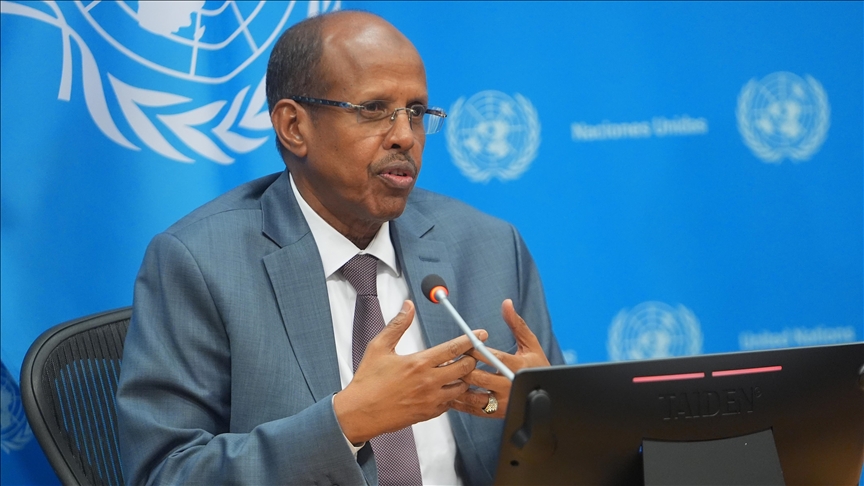
Speaking at the 7th African Union–European Union Summit in Luanda, Angola, AU Commission Chair Mahmoud Ali Youssouf expressed deep concern about the rapidly shifting global landscape. He noted that rising geopolitical tensions, increasing conflicts, acts of terrorism, and extremist movements have created widespread instability and allowed international norms to erode.
Youssouf warned that international law is losing strength, and Africa—already facing political turmoil, security threats, and significant development challenges—feels the impact more than most regions. He argued that the current international system is struggling to function as intended, pointing out that the WTO’s rules are frequently disregarded and the UN Security Council often fails to act effectively due to disagreements among powerful nations.
Reaffirming the AU’s position based on the Ezulwini Consensus, Youssouf declared, “Africa deserves its rightful place at the global decision-making table.” He insisted on both permanent representation on the UN Security Council and equitable shares in international financial institutions, saying these steps are essential for correcting historical marginalization.
Youssouf further called for a significant overhaul of the global financial architecture, arguing that Africa faces disproportionately high borrowing costs and limited access to development financing. He said European nations must help drive this reform, especially since Africa is rapidly evolving from being just a raw materials supplier to becoming an emerging hub for manufacturing and value-added production.
The AU chief urged Europe to invest more in local mineral processing, eliminate tariff and non-tariff barriers on African exports, and strengthen trade partnerships to ensure mutual benefit. He added that the future of global cooperation must be built on fairness, respect among nations, and a renewed commitment to multilateralism that works for everyone—not only the most powerful.
‘Multipolarity alone does not guarantee peace’
UN Secretary-General Antonio Guterres, speaking at the same summit, noted that the world is undergoing a transition toward multipolarity, with power becoming distributed among more states. However, he cautioned that without strong global governance systems, multipolarity can lead to fragmentation rather than stability.
Guterres highlighted the crucial role the Africa–Europe partnership could play in shaping this new global order, calling it an opportunity to correct longstanding inequalities. He compared today’s evolving geopolitical landscape to pre-1914 Europe, which was multipolar but lacked robust multilateral structures—ultimately contributing to the outbreak of war.
The UN chief cited several current conflicts—including the ongoing war in Ukraine, violence in Gaza, and crises in countries such as Sudan, Libya, Mali, Somalia, and the Democratic Republic of the Congo—as evidence of the urgent need for stronger global cooperation. He stressed that the 2024 Pact for the Future recognizes the necessity of permanent African seats on the Security Council, calling it essential for global peace and fairness.
Guterres also reiterated the call for dependable, long-term funding for AU-led peace operations, praising the EU for supporting efforts to strengthen the AU’s peace and security role.
Europe calls for deeper partnership and a just green transition
European Commission President Ursula von der Leyen addressed economic challenges affecting both regions, noting that several strategic sectors are facing significant overcapacity worldwide. She urged Africa and Europe to collaborate more closely to create jobs, support young people, diversify economies, and build more resilient supply chains.
Von der Leyen outlined ongoing Europe–Africa initiatives, such as the Lobito Corridor infrastructure project, programs to help African producers meet European market standards, and support for the African Continental Free Trade Area (AfCFTA). She contrasted Europe’s investment model with that of some other global actors, stating that Europe aims to build industries that rely on local workers, local value creation, and sustainable development rather than practices that extract resources and leave countries heavily indebted.
She highlighted successful partnerships in sectors like mineral processing in Namibia and Zambia, pharmaceutical manufacturing in West Africa, and digital connectivity—such as new undersea data cables linking the continent.
Despite Africa holding 60% of the world’s solar potential, von der Leyen noted that the continent receives only a small share—around 2%—of global clean energy investments. As a result, hundreds of millions still lack electricity or access to clean cooking solutions.
To address these gaps, she promoted the Scaling Up Renewables in Africa initiative, launched in 2024 alongside South African President Cyril Ramaphosa, which seeks to expand renewable energy access on a massive scale. She also highlighted Europe’s pledge of over €400 million to help finance clean cooking projects across Africa.
Von der Leyen emphasized that the global energy transition must be inclusive, stating, “A truly just transition must benefit everyone—and it must be built in partnership with Africa.”
