


Scotland London Africa Week 2025 has wrapped up with overwhelmingly positive feedback from participants, who described the series of events as energising, insightful, and highly productive for strengthening partnerships between Scotland, London, and African nations. The week-long programme brought together influential leaders from government, business, finance, and international trade to explore new opportunities for collaboration and deepen commercial ties between the United Kingdom and Africa.
The opening session took place at Old Admiralty House, where the Department for Business and Trade’s Africa team delivered a strategic briefing. Delegates were introduced to the UK Government’s 10-year industrial strategy and its eight key growth sectors. The discussion also examined the UK’s approach to global trade agreements, including aspects related to skills development and planning reform, and highlighted how the department works closely with international partners while staying focused on priority economic opportunities.
Officials shared updates on more than 130 projects supported through the Ricardo Fund, as well as progress on the UK’s Critical Minerals Strategy, Nigeria’s ETIP programme, and the SACUM tariff review. Ben Ainsley provided a comprehensive market overview across major African economies, noting Africa’s growing significance as it is expected to account for nearly 30% of the global population by 2050. His briefing covered economic developments in Egypt, South Africa, Ethiopia, Uganda, Cote d’Ivoire, Senegal, Kenya, Ghana, Morocco, and Nigeria.
A dynamic roundtable followed, with delegates engaging in discussions on finance, clean energy, supply chain standards, and food security. The group later proceeded to Marlborough House for a session hosted by the Commonwealth Secretariat and the South African Chamber of Commerce UK. Delegates learned that South Africa remains the UK’s largest trading partner on the continent, with trade ties that go far beyond goods and extend into sectors where Scotland has strong expertise. The day concluded with an informal dinner that encouraged open networking and relationship building.
The next morning began at the Egyptian Bureau for Cultural & Educational Affairs, where Minister Plenipotentiary Wael Abdelraheem and the Egyptian British Chamber of Commerce provided an in-depth briefing on Egypt’s trade and investment environment. Delegates then received practical guidance on trade documentation and visa processes before attending a networking lunch hosted by the National Bank of Egypt UK.
In the afternoon, the delegation visited the Embassy of Ethiopia. The Ambassador welcomed the group with an authentic Ethiopian coffee ceremony and shared detailed insights into Ethiopia’s rapidly expanding economy. With a population of more than 120 million and a highly capable workforce, Ethiopia is opening multiple sectors for investment. Key opportunities include agribusiness, agro-processing, dairy and meat production, packaging, and machinery supply. The government’s development of integrated agro-industrial parks further widens the space for investment in cold-storage systems, logistics, and equipment.
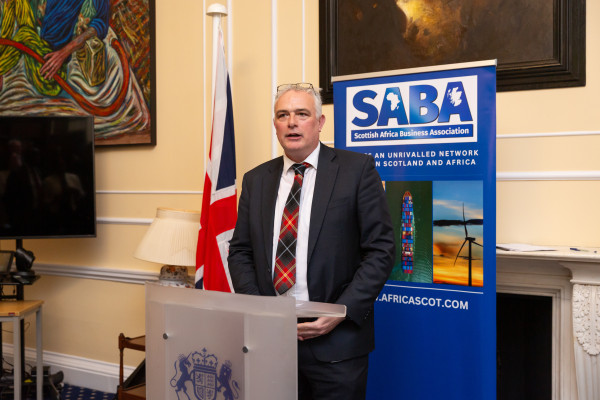
One of the week’s standout moments came during an evening reception at Dover House, hosted with permission of the Secretary of State for Scotland, The Rt Hon Douglas Alexander MP. Over 60 dignitaries, business leaders and representatives from across the UK and Africa attended. Anna Macmillan delivered the keynote address, with Ebury and Diageo partnering as event supporters. Delegates enjoyed Diageo’s expertly crafted whisky cocktails, while Ebury emphasised the critical importance of global trade in achieving resilience and sustainable growth for modern businesses.
The final day of the programme was held at Scotland House and focused on the Scotland-Africa Women in Business event. The session brought together global experts and speakers from the Women in Trade Hub, sparking vibrant discussions on the Scottish Government’s Gender Export Gap and highlighting pathways to strengthen women’s participation in international trade. Delegates exchanged ideas, shared experiences, and formed new connections that will support future collaboration.
Frazer Lang, CEO of the Scottish Africa Business Association (SABA), reflected on the impact of the event, saying:
“This year’s Scotland London Africa Week has delivered a real sense of purpose and progress. The depth of engagement from partners across government and industry has been outstanding and the enthusiasm from our delegates shows just how much potential there is for Scotland and Africa to grow together.”
COO Seona Shand added:
“The discussions this week were refreshing, honest and ambitious. Delegates left motivated and better connected, and it is clear that Scotland’s expertise aligns strongly with the priorities of many African markets.”
Scotland London Africa Week 2025 demonstrated the powerful impact of direct engagement, knowledge exchange, and international collaboration. With active participation across multiple sectors, the event showcased Scotland’s growing commitment to expanding economic partnerships with Africa—and highlighted SABA’s crucial role in strengthening these strategic links.
About the Scottish Africa Business Association (SABA)
SABA is a leading non-political, Africa-focused membership organisation dedicated to advancing trade, investment, and knowledge sharing between Scotland and key African markets. With a highly experienced board, SABA promotes collaboration across critical sectors including agriculture, energy, healthcare, the blue economy, education, and skills development. The association organises private meetings, roundtables, research initiatives, trade missions, and conferences to strengthen commercial ties between Scotland and Africa.
