



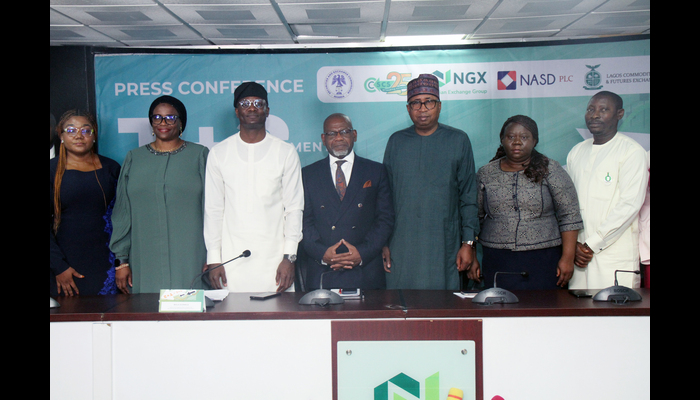
Nigeria has taken another major leap in modernizing its financial markets, officially transitioning to a T+2 settlement cycle on November 28. This shift, led by the Central Securities Clearing System (CSCS Plc), means that trades on the Nigerian Exchange (NGX) and NASD OTC market will now be fully settled within two working days, improving efficiency and aligning the country with global standards.
With this development, Nigeria becomes the first country in sub-Saharan Africa to implement T+2 and only the second in all of Africa, following Egypt’s transition in 2022. Even more remarkably, the CSCS has already begun preparing for a move to T+1 by 2026, and Managing Director Haruna Jalo Waziri hinted that the upgrade could arrive as soon as May next year.
Speaking at the launch event, Jalo Waziri explained that T+1 work is “already ongoing,” adding that the transition positions Nigeria to operate one of the fastest and most competitive stock markets on the continent. CSCS Chairman Temi Popoola emphasized that the achievement reflects Nigeria’s dedication to “efficiency, transparency, and global competitiveness” in its capital-market reforms.
Regulatory support has also been key. The Securities and Exchange Commission (SEC) embedded the shift from T+3 to T+2 in its long-term Capital Market Master Plan. SEC Executive Commissioner Bola Ajomale, representing the Director General, gave a historical perspective, recalling when settlements took “two full weeks” during the era of physical trading floors. Today’s technological advancement, he said, represents a dramatic transformation and an important step toward investor confidence.
Cost and Infrastructure Investment
CSCS reported spending just under N1.3 billion on the transition—less than 4% of its 2024 revenue—thanks to steady infrastructure investments over the past several years. The last major system upgrade occurred in 2017, and another may not be required for as long as a decade. Rather than high spending, Jalo Waziri noted that the real challenge was preventing unnecessary upgrades while still maintaining risk-free operations.
Technology Behind the Upgrade
The transition relied on enhancements to CSCS’s long-standing TCS BaNCS core system—developed by Tata Consultancy Services—rather than a complete replacement. The institution also upgraded from IBM Power8 to IBM Power10 servers, increasing processing capacity while maintaining system stability.
Jalo Waziri compared the upgrade to “increasing speed from 60km/h to 100km/h—same car, same driver, but with improved control.” The most sensitive risk involved updating TCS BaNCS without disrupting its middleware, so CSCS performed extensive reviews to prevent the type of system failures that other institutions experienced during rushed software upgrades.
Impact on Nigeria’s Investment Appeal
The T+2 shift is viewed as an essential milestone in Nigeria’s broader effort to strengthen investor trust. Coming shortly after Nigeria’s removal from the FATF grey list, the upgrade signals to domestic and foreign investors that the country is aligning its markets with global best practices.
With a T+1 cycle already in progress, Nigeria is signaling that it intends to compete with the world’s most advanced financial markets, positioning itself as a more attractive destination for portfolio investors, institutional players, and international capital flows.
