

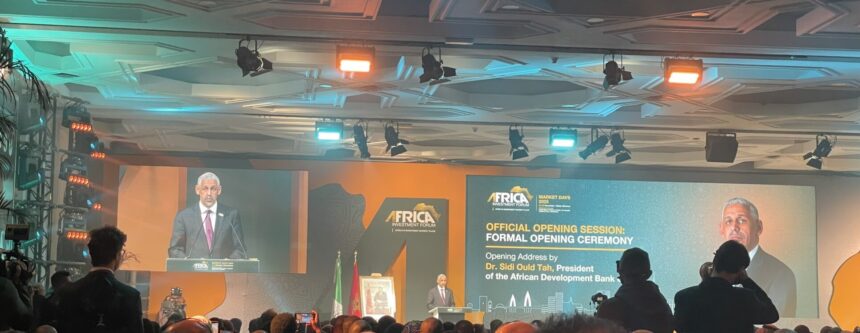
African Development Bank (AfDB) President Sidi Ould Tah has called on African governments, financial institutions, and development partners to significantly scale up efforts to attract private capital as the continent faces an increasingly urgent development and infrastructure financing gap.
He made the appeal during the opening ceremony of the 2025 Africa Investment Forum (AIF) in Rabat, which commenced on 26 November with the theme, “Bridging the Gap: Mobilising Private Capital to Unlock Africa’s Full Potential.” The AfDB President outlined four major strategic priorities that will guide the Bank’s work going forward, stressing the need for decisive action and stronger collaboration across all levels of the continent’s financial ecosystem.
Ould Tah underscored that Africa must accelerate the mobilisation of equity and partner funds using innovative financing mechanisms that can multiply investment impact—potentially turning every dollar injected into ten dollars of unlocked opportunity. According to him, such mechanisms are essential for attracting large-scale private sector participation capable of transforming the continent’s economic prospects.
He also announced that the AfDB intends to push forward a structural reform of Africa’s financial architecture, introducing a coordinated model operating at national, regional, and continental tiers. This approach, he explained, would strengthen institutional alignment, improve resource flow, and ensure that financial actors operate more efficiently.
Beyond capital mobilisation, the AfDB President emphasised converting Africa’s rapidly growing population into an economic engine. This includes boosting financial inclusion, supporting youth and women through entrepreneurship programmes, and deepening skills development—particularly in digital and STEM fields. He further stressed the urgent need for resilient infrastructure and enhanced value addition in natural resources through improved energy systems, transport logistics, digital connectivity, and industrialisation.
Ould Tah cautioned that Africa’s demographic path—projecting the continent to host a quarter of the global population by 2050—could become an economic burden instead of an asset if not supported by strategic, long-term investments and strong structural transformation.
Morocco’s Minister of Economy and Finance, Nadia Fettah Alaoui, reaffirmed her country’s determination to create an environment conducive to private investment and robust public–private partnerships. She highlighted Morocco’s target of ensuring private investment accounts for two-thirds of national investment by 2035, powered by regulatory reforms, infrastructure expansion, and industrial modernisation.
The Minister noted that Africa requires an estimated $1.3 trillion annually to meet its broader development targets, emphasising that innovative financing and deeper cooperation between public and private stakeholders are essential to closing this gap.
The 2025 AIF convenes governments, development finance institutions, and global investors to accelerate high-impact projects across critical sectors such as energy, transportation, logistics, and digital infrastructure. Since its establishment in 2018 by the AfDB and its partners, the Forum has become a key platform for mobilising private capital for transformative initiatives across Africa. The continent’s infrastructure needs alone are estimated at $130–170 billion per year, far beyond the capacity of public budgets. To date, the AIF has generated more than $225 billion in investment interest, with over $32 billion in deals successfully reaching financial close.
